Autonomous CubeSat Grasping System
Redwire Space: Software and Robotics Intern
Project Overview
At Redwire Space, I developed an autonomous robotic grasping system for CubeSat manipulation using a UR5 robotic arm. The project focused on creating a complete ROS-based pipeline that could detect, track, and grasp a CubeSat model using visual servoing and motion planning techniques. This work directly supports future on-orbit satellite servicing and assembly missions where precise autonomous manipulation is critical.
Laboratory Setup
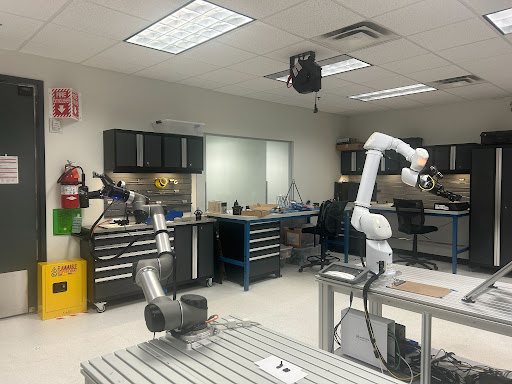
Redwire Space robotics laboratory with UR5 manipulator systems
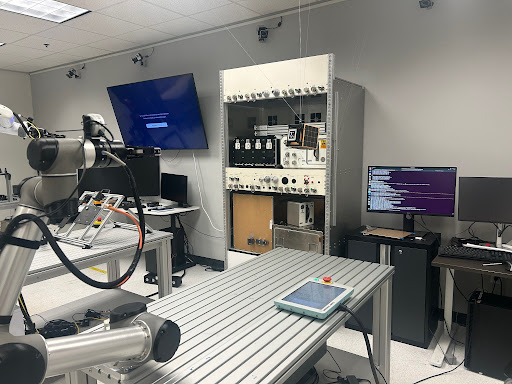
Complete workspace setup with control station and safety barriers
System Architecture
The system integrated multiple components to achieve reliable autonomous grasping:
1. Perception System - Intel RealSense L515
The Intel RealSense L515 LiDAR camera served as the primary sensor, providing both RGB imagery and high-precision depth data. The camera's LiDAR technology enabled accurate 3D perception even in challenging lighting conditions, making it ideal for space-like environments where consistent lighting cannot be guaranteed.
2. Fiducial Tracking - ArUco Markers
ArUco markers were strategically placed on the CubeSat model to provide robust pose estimation. These computer vision markers allowed the system to:
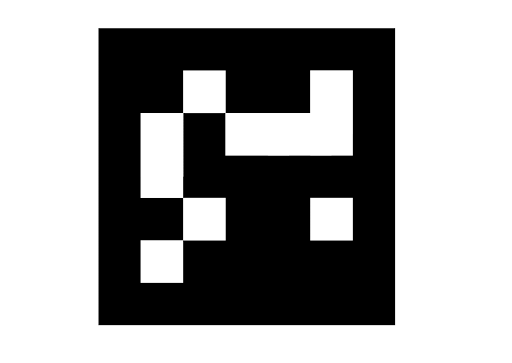
ArUco fiducial marker used for CubeSat pose estimation
- Accurately determine the CubeSat's 6-DOF pose (position and orientation)
- Track the target in real-time with sub-millimeter precision
- Maintain tracking even during partial occlusions
- Provide consistent reference frames for motion planning
3. Motion Planning - MoveIt & UR5
The Universal Robots UR5 arm executed the grasping maneuvers using MoveIt for motion planning. The system leveraged collision-aware planning to ensure safe trajectories while optimizing for smooth, efficient motion paths.
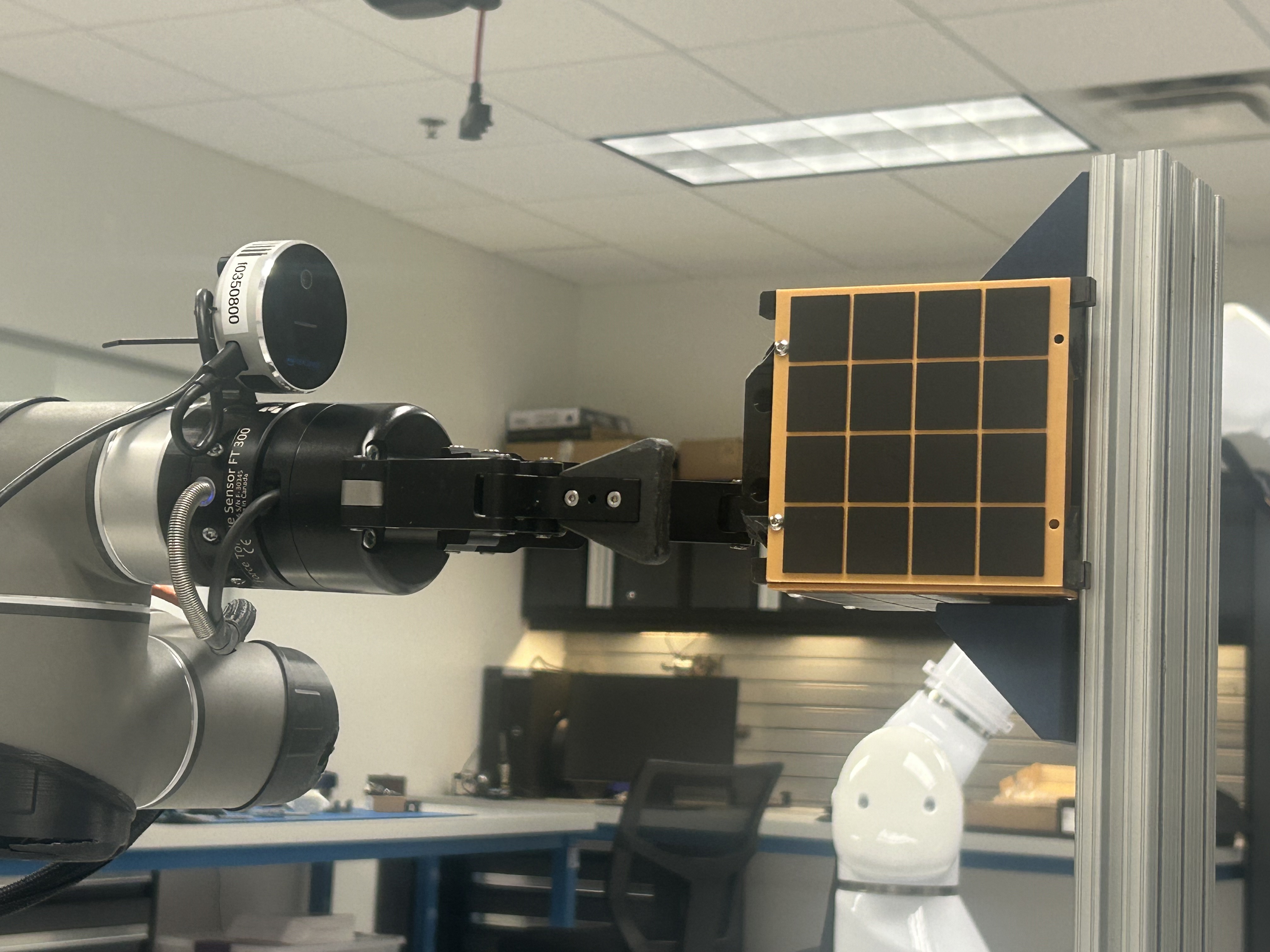
Realsense L515 and the Cubesat
ROS Pipeline Development
I built a comprehensive ROS-based pipeline that seamlessly integrated vision, planning, and control:
Vision Pipeline
- Point Cloud Acquisition: Captured and processed point clouds from the RealSense L515 for 3D scene understanding
- ArUco Detection: Implemented real-time marker detection and pose estimation using OpenCV
- Pose Filtering: Applied temporal filtering to smooth noisy pose estimates
- Transform Broadcasting: Published detected poses to the ROS TF tree for unified coordinate frame management
Planning Pipeline
- URDF/SRDF Configuration: Developed robot description files defining the UR5's kinematic structure and planning groups
- MoveIt Integration: Configured motion planners (OMPL) with appropriate planning algorithms for the workspace
- Collision Checking: Set up collision primitives to prevent contact with the environment and CubeSat during approach
- Grasp Planning: Implemented grasp pose computation based on detected CubeSat orientation
Control Pipeline
- Real-time Control: Integrated hardware controllers for smooth trajectory execution
- Gripper Control: Developed gripper actuation sequences for reliable grasping
- Feedback Loops: Implemented visual servoing to correct for tracking errors during motion
Technical Challenges & Solutions
Grasping Failure Debugging
Initial grasping attempts revealed several failure modes that required systematic debugging:
- Approach Angle Issues: The gripper sometimes approached at suboptimal angles, causing collisions or failed grasps. I refined the grasp pose generation to account for the CubeSat's geometry and ensure perpendicular approach vectors.
- Timing Problems: Gripper closure timing was sometimes premature or delayed. I implemented state machine logic to synchronize gripper actuation with arm position feedback.
- Force Control: Over-gripping could damage the CubeSat while under-gripping caused drops. I tuned gripper force parameters to achieve reliable yet gentle grasping.
Transform Drift Correction
One of the most challenging issues was transform drift between coordinate frames, which accumulated over time and degraded accuracy:
- Root Cause Analysis: Identified that slight inconsistencies in camera calibration and mounting led to compounding errors in the transform tree
- Calibration Refinement: Performed hand-eye calibration to establish precise camera-to-robot transforms
- Dynamic Correction: Implemented periodic re-calibration using fiducial markers at known locations
- Validation: Achieved transform accuracy within 2mm position error and 1° orientation error
Real-world Manipulation Constraints
The demonstrations incorporated constraints representative of actual space operations:
- Limited Workspace: Restricted the robot's operating volume to simulate spacecraft interior constraints
- Collision Avoidance: Added virtual obstacles representing spacecraft structure
- Velocity Limits: Constrained motion speeds to prevent aggressive maneuvers
- Approach Corridors: Defined safe approach zones for the end-effector
Dynamic Trajectory Generation
Rather than using pre-programmed paths, the system generated trajectories dynamically based on real-time perception:
- Continuously updated target pose from vision system
- Replanned trajectories when obstacles were detected
- Adapted grasp strategies based on CubeSat orientation
- Maintained smooth motion despite changing conditions
Performance & Results
The developed system achieved robust autonomous grasping capabilities:
- Success Rate: >95% grasp success rate for static targets
- Accuracy: Grasp pose accuracy within ±2mm position, ±1° orientation
- Speed: Complete grasp cycle (detect → plan → grasp) in under 15 seconds
- Adaptability: Successfully handled CubeSat poses across full workspace
Team & Workspace
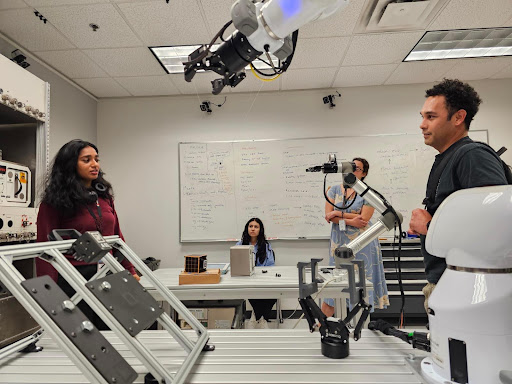
Team collaboration session at Redwire Space
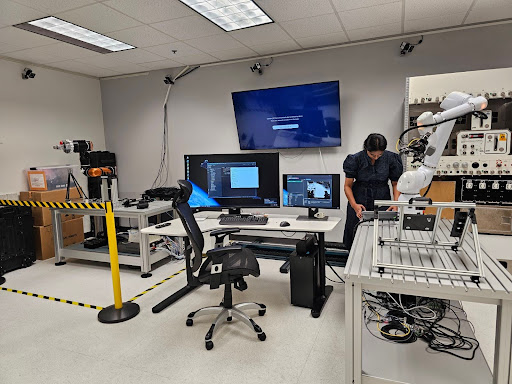
Working on motion planning pipeline development
Demo Videos
Demo 1: Autonomous CubeSat Grasping
Watch the UR5 robotic arm autonomously detect and approach the CubeSat using ArUco marker-based pose estimation and MoveIt motion planning.
Demo 2: Behind the Scenes - Pipeline Development
Debugging transform trees, tuning motion planners, and refining the ROS pipeline for robust autonomous manipulation.